Misminay Community: Andean life, Inca astronomy, and community tourism
There are places in the Sacred Valley that do not appear on standard tourist circuits but that preserve something the great archaeological sites cannot offer: the daily life of an Andean community that has spent centuries looking at the same sky the Incas once looked at. Misminay is one of those places, and those who visit it quickly understand why its own inhabitants renamed it Qoyllur Qhawaqkuna Llaqta, which in Quechua means the town of star watchers.
Where it is and how to get there
Misminay is a peasant community located about 50 kilometers from Cusco, very close to Moray, in the district of Maras, province of Urubamba. It is at 3,700 meters above sea level and is made up of approximately 500 community members. Access from Cusco to Chinchero is by paved road and from Maras to Misminay by dirt road. The transfer from Cusco takes around 90 minutes and from Moray about 20 minutes, which makes it a natural stop for those visiting the Maras salt mines and the agricultural laboratory of Moray on the same route.
Misminay’s relationship with the stars
This community’s connection with the night sky is not a recent tourist invention. It has deep roots in the Inca worldview and in a practice that remained alive for centuries.
Anthropologist Gary Urton lived in the community in the late 1970s and documented in his book At the Crossroads of the Earth and the Sky the astronomical and cosmological system that the inhabitants kept active in their daily lives. Urton asked a young man from the village why every night everyone observed the Pleiades so carefully, known locally as the Qullca. The answer was direct and powerful: because we want to live.
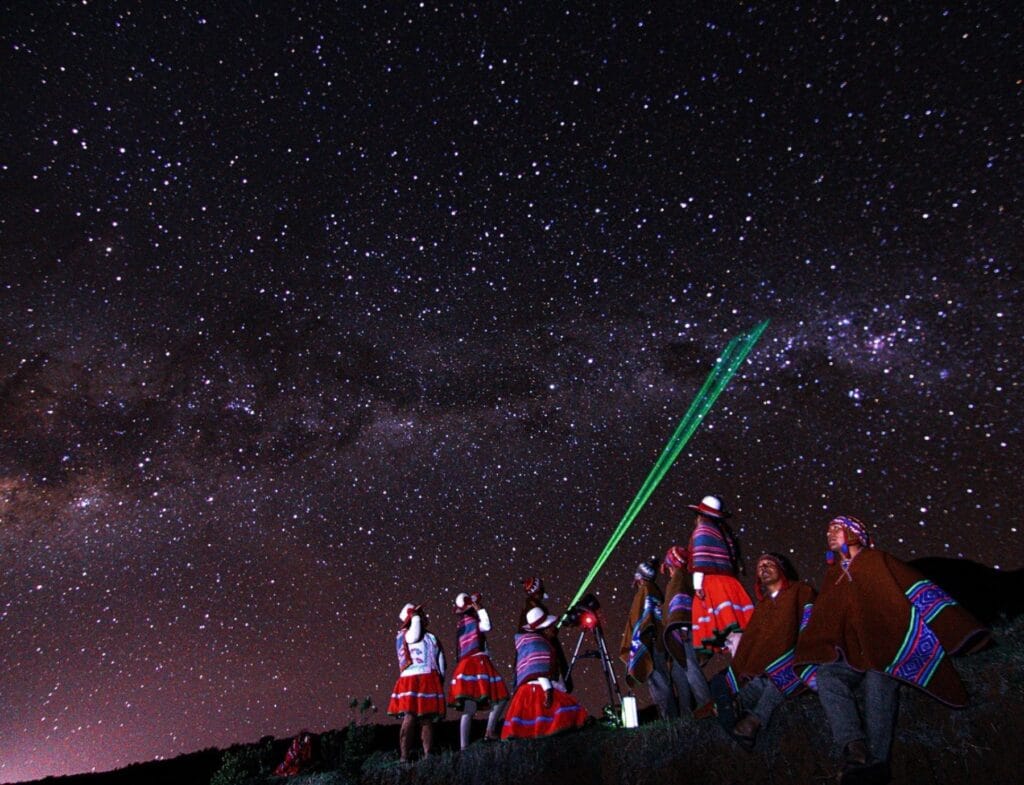
That phrase sums up the relationship that the Incas and their descendants have with the sky. The stars are not objects of contemplation but instruments of agricultural, meteorological, and spiritual prediction. The position of the Pleiades at dawn indicated when to plant potatoes. The Milky Way, called Mayu or celestial river in Quechua, organized the ritual calendar. In the Andean worldview of Misminay, the sky is divided by the intersection of two axes formed by the Milky Way crossing the zenith, creating a mirror image of the territorial division of the land they inhabited.
The first Starlight Site in Peru
Since 2008 the community has been working on the development of community-based rural tourism and since 2020 it has actively promoted astrotourism as part of that model. That effort was officially recognized when Misminay was declared the first Starlight territory in Peru, a certification granted by the Starlight Foundation to places that must be preserved for the enjoyment of sky observation and the protection of the natural and cultural resources associated with it.
The community has telescopes, binoculars, and a stone map of the Milky Way with the Andean constellations that Gary Urton himself left as a legacy of his research. Trained local residents guide visitors in reading the night sky from the perspective of Inca astronomy, distinguishing constellations of luminous points from constellations of darkness formed by the nebulae of the Milky Way, which the Incas identified as sacred animals: the llama, the serpent, the toad, the fox.
The daily life that can be shared
Astronomy is only one part of what Misminay offers. The community tourism it has developed includes experiences that fill the entire day before night falls and the sky becomes the main character.
The community welcome
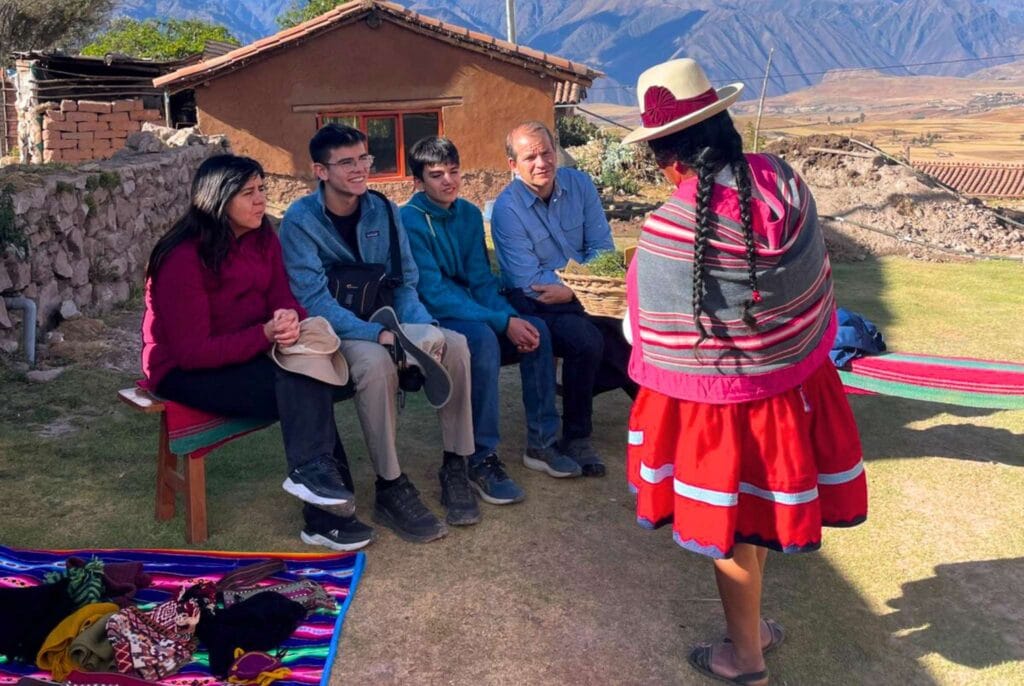
Upon arrival, visitors receive a welcome with music, dancing, and traditional clothing from members of the community. It is not a performance prepared for tourists but a form of reception that is part of the Andean tradition of hospitality toward visitors who arrive from far away.
Textile work with ancestral techniques
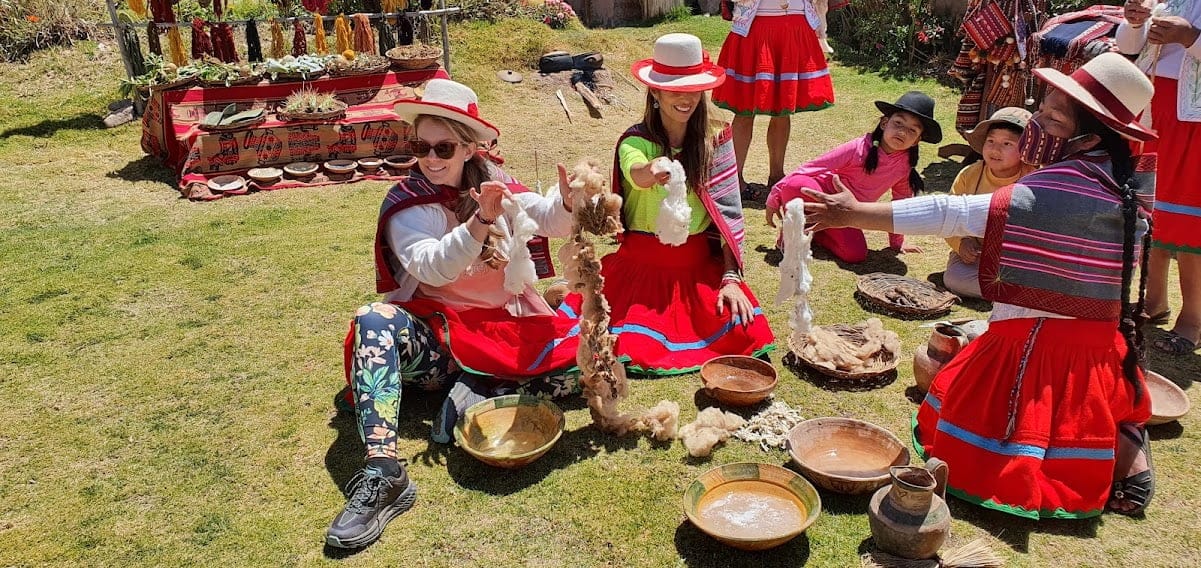
The community has recovered and enhanced the production of textiles using original techniques. The process includes making Andean textiles with wool dyed with plants, minerals, and natural materials under the system called Away, using tools such as small wooden boards and animal bones that the residents themselves make. Participating in that workshop does not only teach a technique. It reveals the relationship that each pattern and color has with the identity, the territory, and the worldview of the person who weaves it.
Andean agriculture with original tools
Visitors can take part in planting and cultivation days using the chaquitaclla, the foot plow of pre-Hispanic origin that is still used in the fields of Misminay. The experience makes it possible to understand the crop rotation and water management system that allowed Andean communities to farm in high mountain areas for centuries without degrading the soil.
Pachamanca and local gastronomy
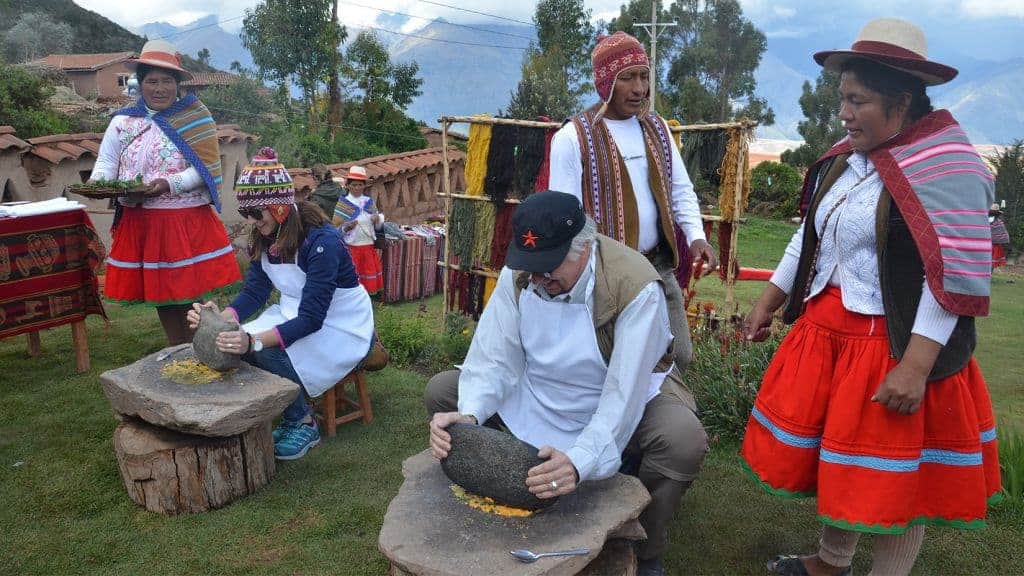
Pachamanca is an ancestral cooking technique in which food is prepared underground with stones heated by fire. Taking part in its preparation within the community is one of the most memorable moments of the day: choosing the stones, arranging the meats and tubers, sealing everything with straw and earth, and waiting before opening the ground to reveal what was cooked inside. The flavor produced by that process is impossible to replicate outside that context.
Night sky observation
Mainly between April and September, those who stay overnight in the community go out to study the sky starting at 10 at night: they observe constellations, planets, stars, and comets together with local guides trained in Andean astronomy. Misminay’s remote location offers one of the clearest night skies in the entire region. Sitting around a bonfire while a resident explains how their grandparents read the sky to know when to plant is an experience that changes the perception of the whole trip.
The impact of community tourism in Misminay
The community has an inclusive organization that involves men and women of all ages, both elders and youth, to preserve their customs while at the same time generating income that improves the collective quality of life. Experiential tourism in Misminay is not only an economic activity: it is also a mechanism for cultural preservation. By having economic value, traditions that would otherwise be abandoned become active heritage that younger generations have an interest in maintaining.
The model applied by the community is based on the principles of Buen Vivir, a philosophy of Andean origin that seeks balance between collective well-being, harmony with nature, and sustainable economic development. It is not tourism that extracts value from a place. It is tourism that returns value to those who live there.
How to combine Misminay with other destinations in the Sacred Valley
Misminay’s location makes it a natural stop within a Sacred Valley route. From the community there are direct views of the circular terraces of Moray and the salt mines of Maras. An itinerary that combines the salt mines in the morning, the agricultural laboratory of Moray at midday, and the community of Misminay in the afternoon with an overnight stay and nighttime astronomical observation is one of the most complete ways to understand the region in a single day and a half.
Visit Misminay with Machu Picchu Viajes Peru
At Machu Picchu Viajes Peru, we include the community of Misminay in our Sacred Valley itineraries for those looking for something more than visiting monuments. We coordinate transportation from Cusco, the experiential day with the community, and if you wish, the overnight stay for nighttime astronomical observation. Tell us how many days you have in Cusco and we will put together an itinerary that combines the great sites of the region with this experience that very few travelers know about and that almost everyone remembers as the best part of the trip.