Plaza Mayor of Lima: Attractions, History and the Changing of the Guard

The Plaza Mayor of Lima is characterized as part of the historic center declared a UNESCO World Cultural Heritage Site. In addition, it features important historic buildings and iconic landmarks that make it one of the most representative spaces in the city.
Within the square, visitors can find different tourist attractions such as the Government Palace, the Basilica Cathedral of Lima, and the Archbishop’s Palace. Since its foundation in 1535 by the Spanish, this place has accumulated great cultural richness, making the plaza a destination with many attractions that can be visited both during the day and at night.
What buildings surround the Plaza Mayor of Lima?
The Plaza Mayor of Lima is surrounded by important historic buildings such as the Government Palace, the Cathedral of Lima, the Archbishop’s Palace, and the Municipal Palace.
Many of these attractions can be appreciated from the plaza itself and are part of the tourist route through the historic center of the city.
Government Palace: The House of Pizarro
The Government Palace, also known as the House of Pizarro, was originally built in a simple style. Years after the death of Francisco Pizarro, which occurred after the attack by followers of Diego de Almagro, the residence began to be occupied by colonial authorities.
Over time, conflicts arose between Pizarro’s heirs and the Spanish Crown. The earthquakes of 1687 and 1746 caused significant damage to the building, which led to several reconstructions. During the Viceroyalty and later in the republican era, numerous renovations were carried out until 1938, when an important reconstruction was completed that included reception halls and other annexed rooms.
The Basilica Cathedral of Lima and the Archbishop’s Palace
The Basilica Cathedral of Lima began as the main church in 1535, until Pope Paul III elevated it to cathedral status on May 14, 1541.
This cathedral is important not only in the ecclesiastical sphere but also in the political, cultural, and artistic life of the country.
Throughout its history, the building underwent several transformations due to the strong earthquakes that affected the city of Lima, as well as renovations carried out for aesthetic purposes. Meanwhile, the Archbishop’s Palace also represents an important place for art and history in Peru. Inside, valuable furniture and historical pieces dating from the 16th to the 19th century are preserved and require special care due to their heritage value.
The Municipal Palace and the iconic colonial balconies
The Municipal Palace of Lima was designed by architect Ricardo de Jaxa Malachowski in a neo-colonial style and was inaugurated in 1944.
Its wooden balconies and columns harmonize with the historic aesthetic of Plaza Mayor while incorporating modern elements characteristic of the urban context of the early 20th century.

History and foundation of the “City of Kings”
The City of Kings, better known as the foundation of the city of Lima, was established in 1535 by a group of Spanish conquerors led by Francisco Pizarro. After the defeat of Atahualpa and the conquest of the Inca Empire, the Spanish Crown granted Pizarro the authority to govern the conquered territory.
During Spanish colonization, the search began for the place that would become the new capital. Although Cusco was initially considered, the valley of the Rímac River, called Limac by the local Yunga people, was eventually chosen. This territory became the City of Kings, the new capital of the Viceroyalty. Throughout its history it endured invasions, wars, and rebellions. Today, Lima enjoys stability and has become a destination that attracts tourists from all over the world.
The bronze fountain and Francisco Pizarro’s city layout
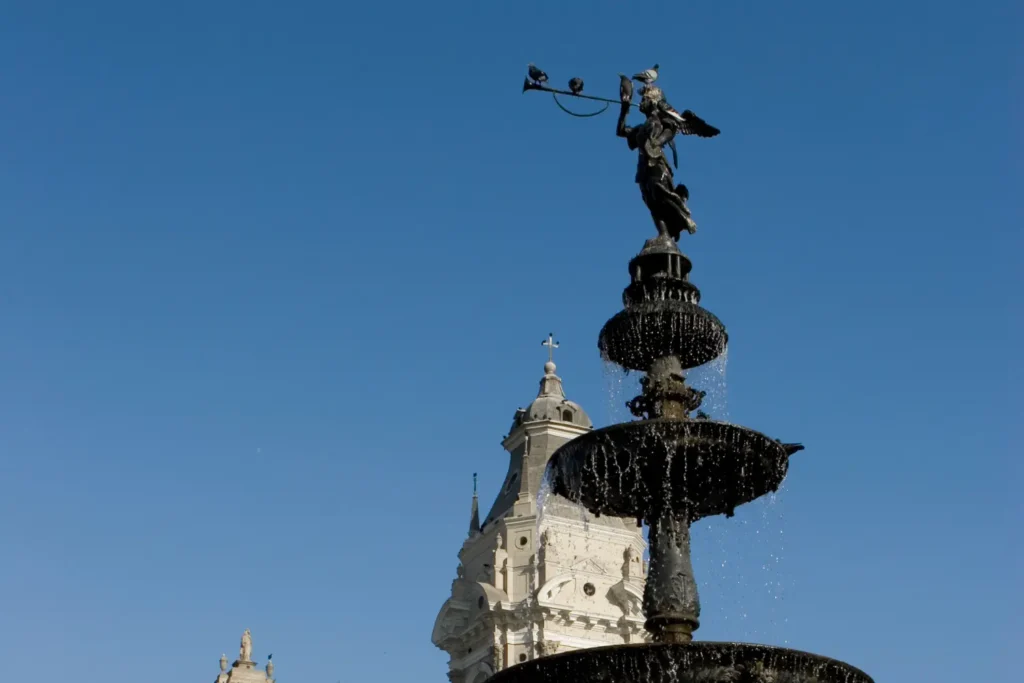
The bronze fountain of Lima was installed in 1651, becoming a colonial icon that has survived earthquakes and many historical events of the city.
Meanwhile, the urban layout designed by Francisco Pizarro consisted of 117 blocks that formed the well-known Pizarro grid plan. Each block or division was assigned to different owners. These lands could be granted to Spaniards of noble origin or to those who had merits within the colonization process. The only obligation was to fence the land within a period of no more than one year. This commitment could also include the granting of another agricultural property within the same valley.
Plaza de Armas as a UNESCO World Heritage Site
The Plaza de Armas was declared by UNESCO in 1991 as part of the Historic Center of Lima, recognized for its high historical and architectural value. This space stands out for its authenticity and for hosting important buildings such as the Cathedral of Lima, the Government Palace, and the historic bronze fountain from 1651.
Must-see activities in Plaza de Armas
Among the activities you can enjoy in Plaza de Armas and its surroundings are the free walking tours, where guides explain the history of the buildings, share local anecdotes, and sometimes even offer small tastings.
You can also watch the changing of the guard at the Government Palace, visit the Archbishop’s Palace Museum, which houses religious and historical collections, or attend free outdoor concerts. Visitors can also enjoy spontaneous artistic performances and walk along nearby pedestrian streets such as Jirón Ucayali and Jirón Carabaya.
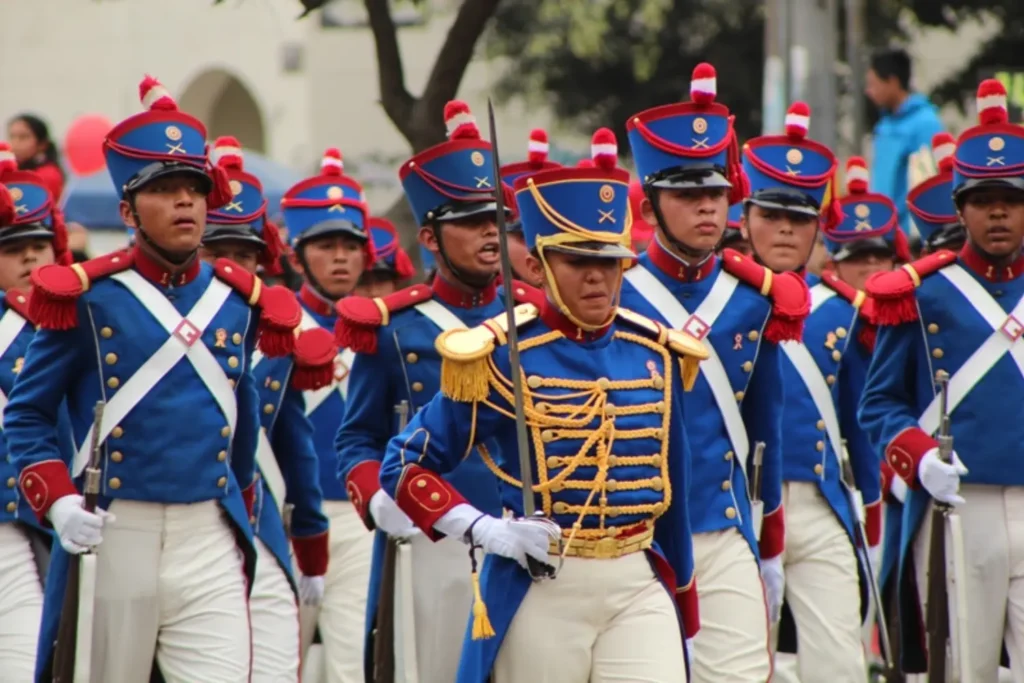
Watch the Changing of the Guard of the Hussars of Junín
The changing of the guard is a ceremony that dates back to the republican era and represents one of the most symbolic military traditions in Peru.
During the ceremony, synchronized movements of the soldiers guarding the government headquarters and presidential residence can be seen, accompanied by the melodies of a military band. This spectacle takes place every day at 12:00 noon.
Night tour: The illumination of the Historic Center
If you want to experience something special in Lima, you can take a night tour through the Historic Center. During this walk you will visit iconic places such as Plaza San Martín, Jirón de la Unión, and Plaza Mayor, while listening to urban legends and historical stories. The tour often includes stops where visitors can taste traditional desserts.
Practical information for your visit
Below are some recommendations for your visit to the city of Lima. Remember that if you need more information you can contact us through our social media channels or website.
How to get to Plaza Mayor by Metropolitano or bus corridor
To reach Plaza de Armas you can use the Metropolitano or the Blue Corridor buses. There is also a free application called Moovit that provides maps, bus stops, and public transportation routes to help you move around the city more easily. Depending on your location, you can also use the Lima Metro (Line 1) or other urban bus routes.
Safety and best times to walk around the center
The best times to walk through the historic center are usually in the morning between 9:00 a.m. and 11:00 a.m., and in the evening between 7:00 p.m. and 9:00 p.m..
Although the area usually has a police presence and is generally safe for visitors, it is always recommended to take basic precautions when exploring the city.
Frequently asked questions about Plaza Mayor of Lima
Below we answer some common questions about visiting Plaza Mayor.
What time is the changing of the guard today?
The changing of the guard takes place every day at 12:00 p.m., although the ceremony usually begins around 11:45 a.m. with the sound of trumpets.
Is it free to visit Plaza de Armas?
Yes, visiting Plaza de Armas is free of charge. It is an ideal place to take photos and enjoy one of Lima’s most iconic landmarks.
What museums are near the plaza?
Nearby museums include the Museum of Art of Lima (MALI) and the Metropolitan Museum of Lima, both located a short distance from the historic center.