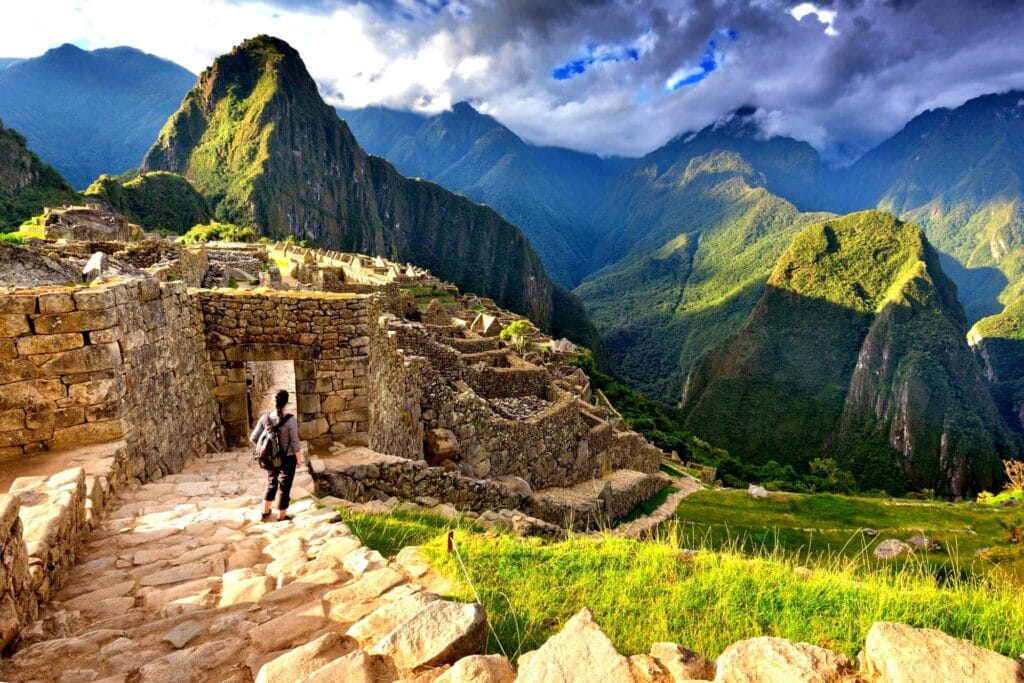
Pallay Punchu: The New Rainbow Mountain

What is Pallay Punchu Mountain of Apu T’akllo?
Pallay Punchu is a high-Andean mountain formation famous for its diagonal multicolored bands that resemble an Andean woven textile (a poncho). In Andean worldview, “Apu” refers to a protective mountain spirit; that’s why you’ll hear the name Apu T’akllo linked to this area (respect, a symbolic offering, and good behavior on the trail are part of the experience).
From a natural standpoint, the colors are explained by layers of sediments and minerals exposed by erosion, creating reddish, ochre, and greenish streaks.
Location: Where is Pallay Punchu?
It’s located in the Cusco region, Canas province, Layo district, very close to Langui–Layo Lagoon.
Several local guides place the area in Cóndor Sayana, between the limits of Layo (Canas) and Marangani (Canchis), near the Cusco–Puno highway (Pan-American).
Helpful reference: it’s often mentioned as being ~189 km (117 mi) south of Cusco.
How to get to Pallay Punchu from Cusco (real routes)
Most used route (recommended): Cusco → Sicuani → Layo
Cusco → Sicuani: bus (about 3 hours).
Sicuani → Layo: shared van/bus/shared taxi (about 1–1.5 hours).
Layo → trailhead: you can hike or take short local transport to the starting point (depending on the season/road conditions).
Alternative route (longer): Cusco → Sicuani → Marangani/Occobamba
This is used if you want a trekking variation, but it’s usually more demanding (a longer hiking section).
Layo District and Langui–Layo Lagoon (to enrich your visit)
Langui–Layo Lagoon is a large high-Andean body of water shared by the districts of Langui and Layo, with an elevation close to 3,955 m = 12,975.72 ft.
Along its shores, it’s common to see totora reeds and high-Andean birds; trout and other species are also often mentioned in the area.


Many travelers combine: lagoon viewpoints + Pallay Punchu on the same day.
Information about prices and entry fees for Pallay Punchu
Here’s something important: the fee can vary because it’s usually paid as a local/community charge at the entrance checkpoint.
Several sources mention an entry fee around S/ 12 – $ 4.
Practical tip: bring cash in soles (S/12 to S/20) per person so you’re not stuck if rates change last minute.
Is it better to go with a tour or on your own?
Going with a tour – Pallay Punchu 1 day is best if you want zero stress.
Advantages:
- Direct transportation and optimized timing (many tours leave very early, around 4:00 am).
- Often includes breakfast/lunch, a professional bilingual guide, a first-aid kit, and optional oxygen.
- Safety and monitoring at all times.
Going on your own—at least the first time—is not recommended, since unfamiliar stops and hiking routes can be uncertain and unsafe.
Altitude and hike difficulty
What elevation is Pallay Punchu at?
The most repeated references place the main panoramic viewpoint at around 4,700 m a.s.l. = 15,419.95 ft, with ranges reaching approximately 4,790 m depending on the route/area.
Physical effort level and hiking time
It depends on access:
- From Layo (classic route): many reports mention 1 to 2+ hours uphill (depending on your pace) with a similar return time.
- Occobamba/alternative route: it can be longer (for example, 4–5 hours round trip reported by some guides).
Tips for altitude sickness at Pallay Punchu
- Acclimatize: ideally 1–2 days in Cusco / Sacred Valley Tour 1 day is a great option.
- Go slow: “short, steady steps” (don’t compete with the mountain).
- Hydration + snacks: water, nuts, chocolate, hard candies.
- Avoid alcohol the night before and eat a light breakfast.
- Coca or muña tea: traditionally used for support; it helps some people (not a miracle cure).
If you have a medical history or concerns, talk to a professional about altitude medication and warning signs.
Best time to visit Pallay Punchu
As a guide, I’d put it this way: you truly enjoy Pallay Punchu when the sky is clear and the ground is firm. That’s why the dry season is usually the best window.

Ideal season (dry): April to October (many sources recommend it for clear skies and less slippery trails).
Some guides extend the “good” dry season into November.
Top months: June–August (fewer rainy days). A climate reference for the province (Canas/Yanaoca area) shows a long “drier” stretch, with July among the months with the fewest rainy days.
What if you go in the rainy season (November–March)?
It’s possible, but you’ll usually find clouds, intermittent rain, and muddy sections, which reduces color clarity and requires extra care on the hike.
Weather in Canas Province: dry season vs. rainy season
In Canas (Layo/Langui), the climate is high-Andean: strong sun and wind during the day, cold nights, and rapid changes.
Dry season (approx. April–October/November): clearer skies and firmer trails (best for photos and safety).
Rainy season (approx. November–March): higher chance of rain and slippery trails.
Even local sources describe April to October as the most favorable time to visit.
What to pack for Pallay Punchu Mountain
This is what saves the day at high altitude:
- Recommended clothing:
- Base layer (thermal or quick-dry shirt).
- Warm layer (fleece or light jacket).
- Windbreaker/rain jacket (a must, even in the dry season).
- Trekking pants.
- Hat and gloves.
- Sunglasses + sunscreen (the high-altitude sun hits hard).
- Trekking essentials:
- Shoes/boots with good grip.
- Trekking poles (very helpful on the way down).
- Water + energy snacks.
- Small backpack + rain poncho.
Frequently asked questions about Pallay Punchu
How long is the full tour from Cusco?
Most commonly it’s a 12 to 13-hour full day (very early departure and return in the afternoon/evening).
The hike can vary depending on the exact starting point: some operators mention ~1.5–2 hours uphill, while other itineraries include longer sections.
Can you rent horses on the route?
Yes, there’s usually an option to rent a horse (ideal if the altitude makes the climb difficult). Some guides mention a reference price of ~S/80 – $28 (it can vary by season and local negotiation).
Is it suitable for kids and older adults?
It depends more on acclimatization and fitness than on “technical” trail conditions:
- It’s not technical, but the altitude is demanding.
- For kids and older adults, it often goes better if they’ve already spent 1–2 days in Cusco/Sacred Valley and go at a slow pace with breaks.
- If someone in the group has limitations, the horse option can make a big difference.
If anyone has heart/respiratory conditions or a strong history with altitude issues, it’s safest to check with a professional first.
Are there basic services in the town of Layo?
Yes, but they’re basic (it’s a rural area).
There is a town/district capital and local activity (Layo is a district in Canas).
Some tours note that, since it’s a rural area, restaurant/service standards are simpler than in the city.
For lodging (if you wanted to stay overnight), there are accommodations/lodges reported on travel platforms.
Guide tip: don’t rely on digital payments; bring cash, toilet paper, and an extra snack.