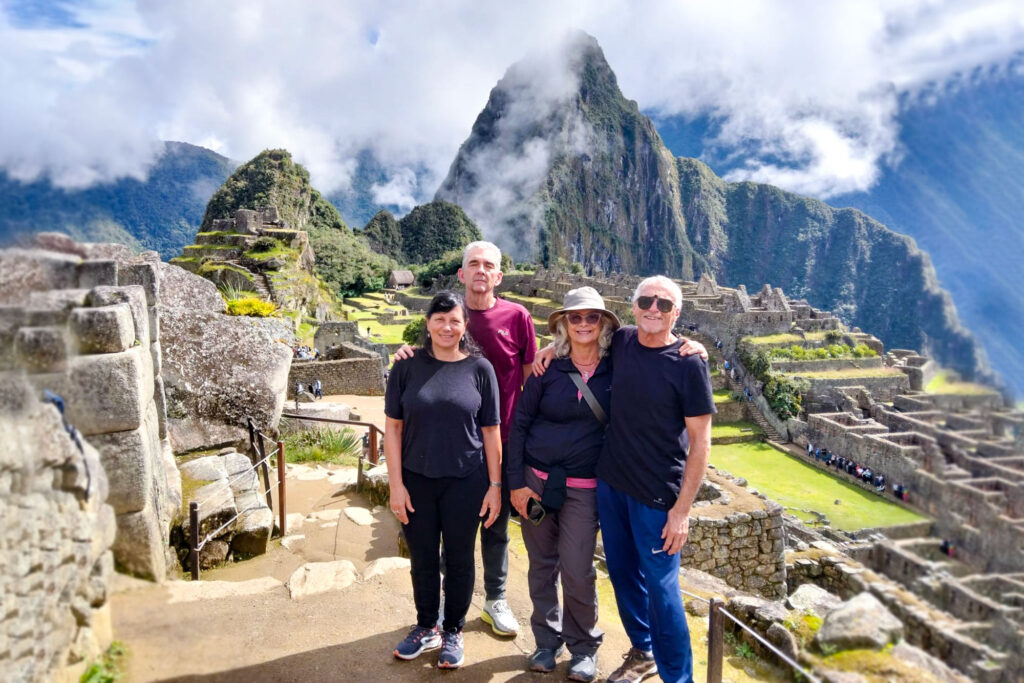
Red Valley of Pitumarca

What is the Red Valley of Pitumarca and why visit it?
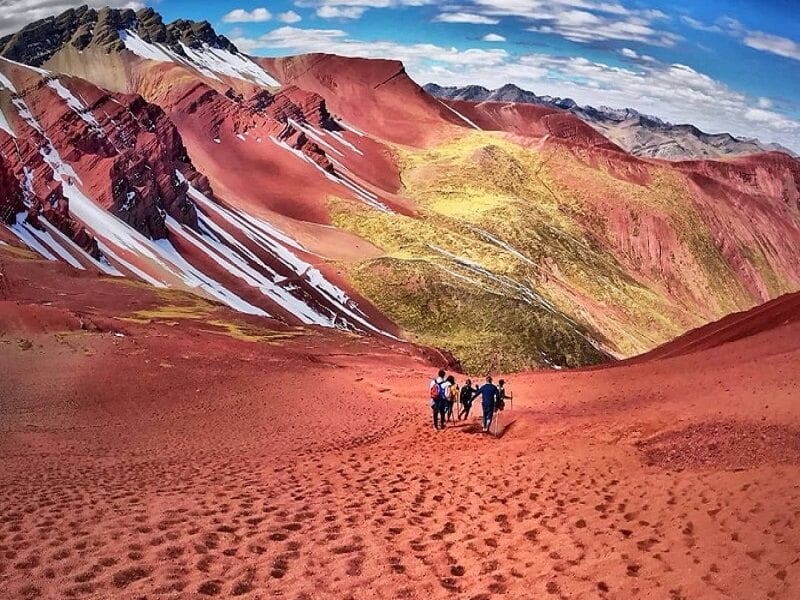
The Red Valley is a set of high-Andean slopes and ravines stained an intense red, very close to Vinicunca (Rainbow Mountain), within the Ausangate / Vilcanota mountain range. Its color comes from the oxidation of minerals (iron, among others) that dye the soil sediments over time.
Why it’s worth it:
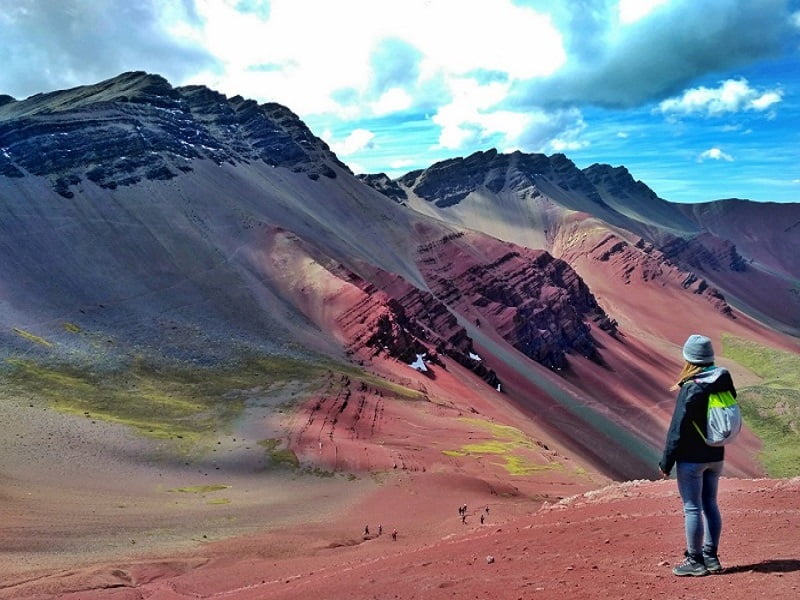
- “Martian” panoramic scenery: from the viewpoint you’ll see red “waves” with green/ochre contrasts and snow-capped peaks in the background.
- Fewer crowds than Vinicunca: it usually feels quieter and more photogenic.
- Cultural add-on (Andean worldview): in local tradition, Ausangate is a protective Apu (sacred mountain spirit), and the area is linked to ancient routes of pilgrimage and exchange in southern Cusco.
- Red river (seasonal): in the rainy season, the reddish tone can be more noticeable in nearby streams.
The route shared with Rainbow Mountain
In practice, the Red Valley is done as an “extension” of the Vinicunca tour, because the detour starts along the same hiking corridor.

Key points about the shared route:
The detour appears near the final section, around the area where horses usually stop before the last uphill push, and it’s marked as a side trail (sometimes with a rope/sign).
From Vinicunca, the section to Red Valley is short:
20–30 minutes (common reference).
There are two common variations:
- Short trail: ~25 minutes (one way).
- Long trail: ~40 minutes (one way), sometimes used for descending to avoid returning the same way.
Location and how to get to the Red Valley of Pitumarca
Location: Pitumarca District, Canchis Province, Cusco Region; roughly 100 km (62 miles) southeast of Cusco and right next to the Vinicunca/Ausangate area.
How to get there (quick and realistic)
1) With a tour (the easiest option)
Leave Cusco before dawn and do the Vinicunca + optional Red Valley circuit in one day (most operators run it this way).
2) On your own (typical route via Pitumarca)
Cusco → Pitumarca: bus from Av. Huayruropata (≈2 hours) S/15 – $5
Pitumarca → starting community (e.g., Japura): shared taxi/collectivo S/30 – $9 (varies).
Hike: from the starting point, approx. 1–2 hours (depending on where you enter and your pace).
What is the hike to the Red Valley like?
Here’s how I’d describe it as a guide: it’s a short trek in distance, but it can feel “long” because of the altitude. You walk through ichu grass plains, open slopes, and natural viewpoints; the scenery gets more dramatic as the reds come into view.
Most helpful for planning:
If you do Vinicunca + Red Valley, the hardest effort is usually Vinicunca, and Red Valley becomes the “extra reward” (more panoramic and less crowded).
Keep in mind there are windy sections and the weather can change fast.
Altitude and difficulty of the Red Valley trek
Red Valley viewpoint altitude: around 5,053 m a.s.l. (16,578 ft)
Vinicunca reaches areas up to 5,200 m – 17,060 ft (according to local references).
Difficulty (honest): moderate to challenging, mainly because of altitude (soroche/altitude sickness), not technical terrain. Typical recommendation: acclimatize 2–3 nights at altitude before attempting it.
Entrance fees and visiting hours in 2026
Tickets (2026)
Here’s something important: fees are community-based and may vary by route/season.
Red Valley (Red Valley only): different amounts are reported:
S/20 (some references)
S/30 cash appears in recent tour listings, documented as a “community fee” in late 2025.
Practical tip for 2026: bring S/30 – $9 in cash per person (small bills) for Red Valley so you won’t fall short if the checkpoint is charging the higher rate that day.
Vinicunca (Rainbow Mountain area): it’s usually charged separately and varies by route (for example, ranges like Peruvians S/10–15 / Foreigners S/25 – $8 are reported by community routes).
Hours (2026)
In general, there isn’t one official “universal schedule,” but it’s recommended to go between 6:00 a.m. and 3:00 p.m. for weather and light.
In practice, some checkpoints work with the idea of allowing visits until around ~2:00 p.m., so it’s best to go early.
Best time to visit the Red Valley of Pitumarca
Best season (safer hiking and clearer skies): dry season, roughly May to October.
Rainy season: (common references) January–March and November–December: colors can look more intense, but there’s more mud and fast-changing weather.
Avoid late afternoons during the rainy season because of electrical storms (this is an open, very high-altitude area).
Frequently asked questions about the Red Valley (Pitumarca)
Is the Red Valley included in the Rainbow Mountain tour?
It depends on the operator and the tour type. In practice, there are two common formats:
“Vinicunca + Red Valley” (included): the tour is already designed with both viewpoints.
“Vinicunca with optional Red Valley” (extra fee): it’s offered as an extension and paid in cash at the community checkpoint (many agencies manage it this way).
Guide tip: if Red Valley is your priority, confirm that your tour states it explicitly (not just “optional”).
How much is the entrance fee for the Red Valley of Pitumarca in 2026?
There isn’t one national “official price list”: the fee is community-based and can vary by route/season.
Practical 2026 recommendation: bring S/ 30 – $ 9 in cash (small bills) so you won’t be short if the higher rate applies that day.
What altitude is the Red Valley at, and how difficult is the hike?
Red Valley viewpoint altitude: around 5,053 m a.s.l. (16,578 ft)
The hike is often labeled “moderate,” but in reality the main challenge is altitude (breathing, pace, cold, and wind), more than the technical difficulty of the trail.
How much extra time does it take to visit the Red Valley from Vinicunca?
Typical:
20–30 extra minutes per section (one way) from the high area of Vinicunca, and similar to return.
Or in other words: about ~50 minutes round trip (depending on the group’s pace and the wind).
Do you need the Cusco Tourist Ticket to enter the Red Valley?
No. The Cusco Tourist Ticket (BTC) is for archaeological parks and museums managed under the BTC system (Sacsayhuamán, Pisac, Ollantaytambo, museums, etc.), and it doesn’t apply to Red Valley/Vinicunca, where you pay a community entrance fee.
What’s the difference between the Red Valley of Pitumarca and Cusipata?
In practice, people use both names because there are two main access routes to Vinicunca, and Red Valley sits nearby as an extension:
Cusipata route (Quispicanchi): the hike usually starts at Phullawasipata and it’s the most popular route.
Pitumarca route (Canchis): it often involves more driving time but can offer a shorter hike (depending on the starting point).
In short: it’s not that there are “two different Red Valleys” as separate attractions; what usually changes is the route, the community checkpoint, and the logistics.
What clothing and gear should I bring for the Red Valley tour?
Think “high mountains in one day”: strong sun + freezing wind + possible drizzles.
- Layers: thermal base layer + fleece + windbreaker/waterproof jacket.
- Gloves + warm hat (the early morning is very cold).
- Trekking shoes with good grip.
- Sunglasses + sunscreen (UV radiation is intense at altitude).
- Water + snacks (chocolate, nuts).
- Cash in soles (entrance fees, restrooms, horse rental if you need it).
- Trekking poles (they help a lot on the descent).
Real-world note: on the Red Valley trail it’s often mentioned there are no restrooms along the route, so use facilities wherever you can before starting.
What’s the best time to visit the Red Valley and see intense colors?
For crisp colors and clear skies, your best bet is the dry season:
April/May through October (many guides recommend it for stability and visibility).
Book your Red Valley + Vinicunca tour with us
If you’d like, we can plan it the way an operations guide would:
Early pick-up (between 4:00 and 5:00 a.m., depending on the route).
Breakfast + lunch, guide, and on-route support (ideally with a first-aid kit and oxygen).
Important: Red Valley is optional (so you know if you’ll pay extra).