Uros Islands in Puno: Visitor Guide, Prices & How to Get There

Contents
- What Are the Uros Floating Islands?
- Location: Where Are the Uros Islands?
- Price and Tour Info (Real Market Ranges)
- How Are the Uros Islands Built?
- What to Do on the Floating Islands (Experiences Worth It)
- Recommendations for Your Visit (Weather, Clothing, and Perfect Timing)
- Frequently Asked Questions About the Uros Islands
What Are the Uros Floating Islands?
The Uros Floating Islands are habitable, man-made islands built with totora (a native aquatic plant from Lake Titicaca). They are part of a living cultural landscape: totora is used for the islands’ ground layer, homes, boats, and other traditional activities.
From a traveler’s perspective, visiting the Uros means meeting a high-Andean lake community and learning about their traditional engineering in a setting that is part of the Titicaca National Reserve.
Location: Where Are the Uros Islands?
- They are located in Puno Bay on Lake Titicaca, very close to the city.
- Several official and tourism sources place them about 7–8 km from Puno (reference distance).
- Area altitude: around 3,800 m a.s.l. = 12,467 ft (approx.)
How to Get to the Uros from the Port of Puno
Typical departure point: the Main Pier/Port of Puno (where boats and tours operate).
Step-by-step (practical):
- Get to the main pier (by taxi or on foot from downtown, depending on your hotel).
- Choose an option:
- Group tour (most common): you join a group and depart with a guide.
- Shared boat/local service: helpful if you’re traveling independently, but you must confirm schedules, which island(s) they visit, and what’s included.
- Confirm before paying:
- Whether it includes entrance fees (Uros / Taquile),
- Whether it includes hotel–pier transfer, a bilingual guide, and
- Whether there are extras (totora reed boat ride, tips, etc.).
Boat Travel Time from the City
On the water, times vary by boat type:
- Standard boat: approx. 25–30 min Puno → Uros.
- Speedboat: approx. 10 min Puno → Uros.
(On the Tour – Uros & Taquile Full Day, what changes most is the travel time Uros ↔ Taquile and the return ride.)


Price and Tour Info (Real Market Ranges)
1) Entrance fee to the Titicaca National Reserve
Here’s an important point: in practice, visits to the Uros are often charged/managed as an “Uros entrance fee (community/islands)” included in the tour, and many operators list those entrance fees as separate items.
In addition, SERNANP promotes buying protected-area tickets through its platform (“Compra tu ticket”), which can be helpful to verify the current ticket options.
Usually the entrance fee is included in the tour; if you go independently, confirm whether they charge it at the pier or on the island (and whether a protected-area ticket applies).
2) Half-day tour prices (Uros)
- Uros tour (half day / group): very commonly around US$18.
3) Full-day tour prices (Uros + Taquile)
Common ranges (depending on boat type and service level):
- Full day on a standard boat: around US$35.
- Full day on a speedboat: around US$38–50.
- In Peruvian soles, you may also see ranges like S/ 140–155 (depending on the boat).
Is It Better to Go on Your Own or With an Agency?
Going independently (on your own)
- Gives you flexibility if you only want Uros and a quick return.
- Risks: what’s included, real timing, guide language, “mandatory” shopping stops, and seasonal changes.
Going with an agency (recommended for first-timers)
- Smoother logistics: set schedules, guide, entrance fees, coordination.
- Best if you want a full-day tour (Uros + Taquile) without wasting time.
- Helpful in high season to avoid improvising.
- You pay a bit more, but there’s less friction (and it’s usually “all included”).
How Are the Uros Islands Built?
Here’s the most valuable part (and what travelers fall in love with when it’s explained well):
- The base: “khili” (blocks of totora roots)
Compact blocks of root/fiber are used to float and act as the “foundation.” - Successive layers of crossed totora (like a giant weave)
Layers are stacked to add thickness, stability, and insulation. - Anchored to the lakebed
To prevent drifting, the islands are anchored with stakes/poles (tour descriptions often mention using eucalyptus). - Constant maintenance
The island “wears out” due to moisture and decomposition, so it is periodically renewed with fresh totora (tour sources often mention frequent renewal).
Totora Use and Island Maintenance (How a Village “Stays Afloat”)
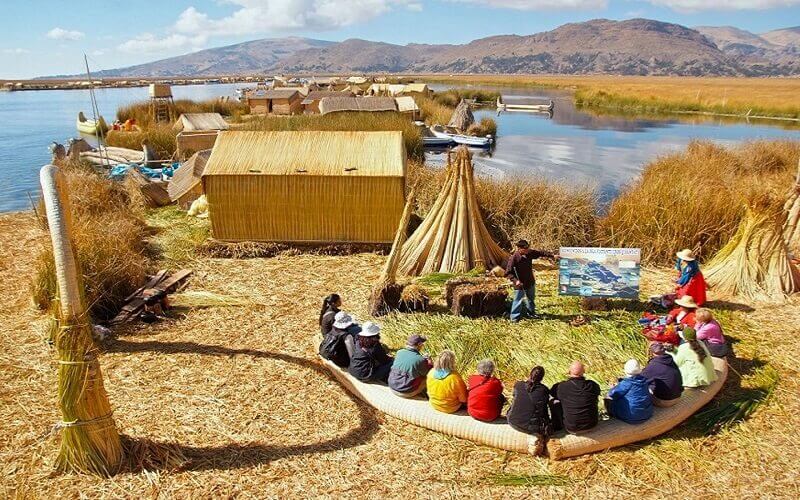
The Uros floating islands are artificial platforms built mainly with totora and a base of compacted roots known locally as khili. To keep them from drifting with wind and currents, they are anchored to the lakebed with stakes/poles (eucalyptus is commonly mentioned in resource descriptions).



Why do they require constant maintenance?
Because totora is living and moist: the lower layers gradually decompose over time, causing the “floor” to lose firmness. The traditional technique is to add new layers of totora on top, reinforcing the surface without rebuilding everything each time (that’s why the ground feels soft, like a firm mattress).
Traditional maintenance (what you’ll see on a guided visit)
- Layer replacement: they add dry totora on top to keep the island stable and “dry” underfoot.
- Checking ties/anchors: especially important on windy days.
- Sustainable management: because they are within a protected natural area (Titicaca National Reserve), totora use follows rules and agreements, and there is regulation for harvesting and management.
Important cultural note: totora management is not only “technique”—in Peru it is recognized as valuable ancestral knowledge.
Traditional Uros Houses and Reed Boats
Totora houses: living architecture
Homes are usually built with braided/interwoven totora, which is lightweight and insulating. It’s quick-response architecture: if there is heavy moisture, the material can be replaced relatively easily. In local tradition, totora is not only for building—it is also used as food and medicine (this is often explained during the cultural demonstration).
Totora boats (“the Uros Mercedes-Benz”)
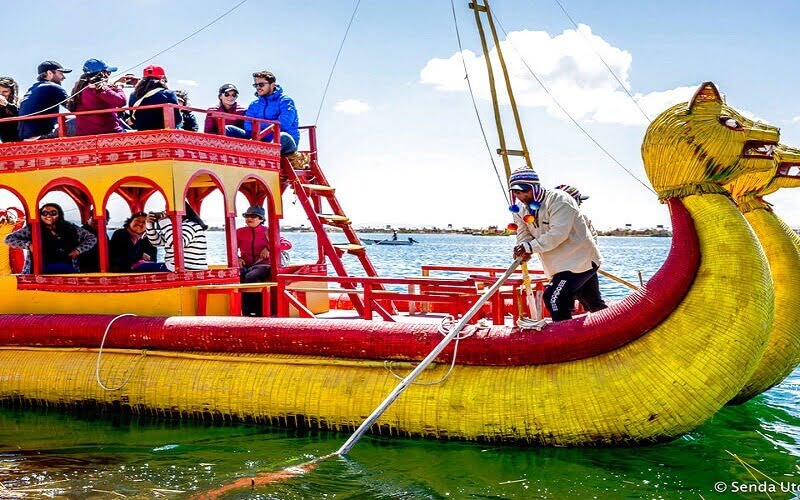
The reed boats are the most photographed symbol: large, stable, with decorated prows. Historically, they were used for transportation, fishing, and connecting islands; today they are also a tourist ride on some routes.
What to Do on the Floating Islands (Experiences Worth It)
1) Totora reed boat ride (optional)
On many visits you’ll be offered a short totora reed boat ride (for example, about 10–15 minutes, depending on the operator and weather). It usually comes at an additional cost.

2) Learn about local life and customs
On a quality visit, they don’t just “show” you—they explain how they live, what changed with tourism, how the community is organized, and how totora supports their economy (housing, crafts, and resource management). You’ll also often hear about language: today, Aymara and Spanish are the most common.
3) Buy handmade crafts and textiles
The most typical items:
- mini reed boats and totora figures,
- textiles/embroidery and local crafts.
Guide tip: ask who made it, how long it took, and buy with intention (one great piece is better than many small ones).
Recommendations for Your Visit (Weather, Clothing, and Perfect Timing)
Weather at Lake Titicaca and What to Wear
You’re in the high plateau (the lake is around 3,812 m a.s.l.), so the weather can change quickly.
In Puno, the climate is often described as cold and dry, with an average around ~9°C, days that can feel warm, and cold nights.
Bring:
- layers: t-shirt + fleece + windbreaker,
- a hat (and if you’re sensitive, thin gloves),
- sunscreen + UV sunglasses (the sun feels stronger due to altitude and reflection off the water),
- water (hydration also helps with altitude).
Best time to visit to avoid the strongest sun
UV radiation can be intense: general advice is to avoid direct exposure between 11:00 a.m. and 3:00 p.m., wear a hat, long sleeves, sunglasses, and sunscreen (SPF 30+).
So if you can choose:
- early (8:00–10:30) or
- late afternoon (after 3:00 p.m.)
Frequently Asked Questions About the Uros Islands
Can you stay overnight on the Uros Islands?
Yes, some islands offer basic lodging (usually community-based tourism). Not all islands have it, so it must be arranged in advance.
Many travelers prefer to stay overnight on Amantaní/Taquile for a longer rural experience, and visit Uros as a shorter cultural stop.
How long does the visit last?
It depends on the tour, but the most common is a half-day visit (about 3 hours) when it’s “Uros + boat navigation,” and longer if combined with other islands.
Is it suitable for kids and older adults?
In general, yes, but with 3 key precautions:
- cold/sun (layers + UV protection).
- altitude (take it slow, hydrate, avoid running).
- uneven footing (totora compresses; wear sneakers with good grip).