Puno Cathedral

What is the Cathedral of Puno and why is it important?
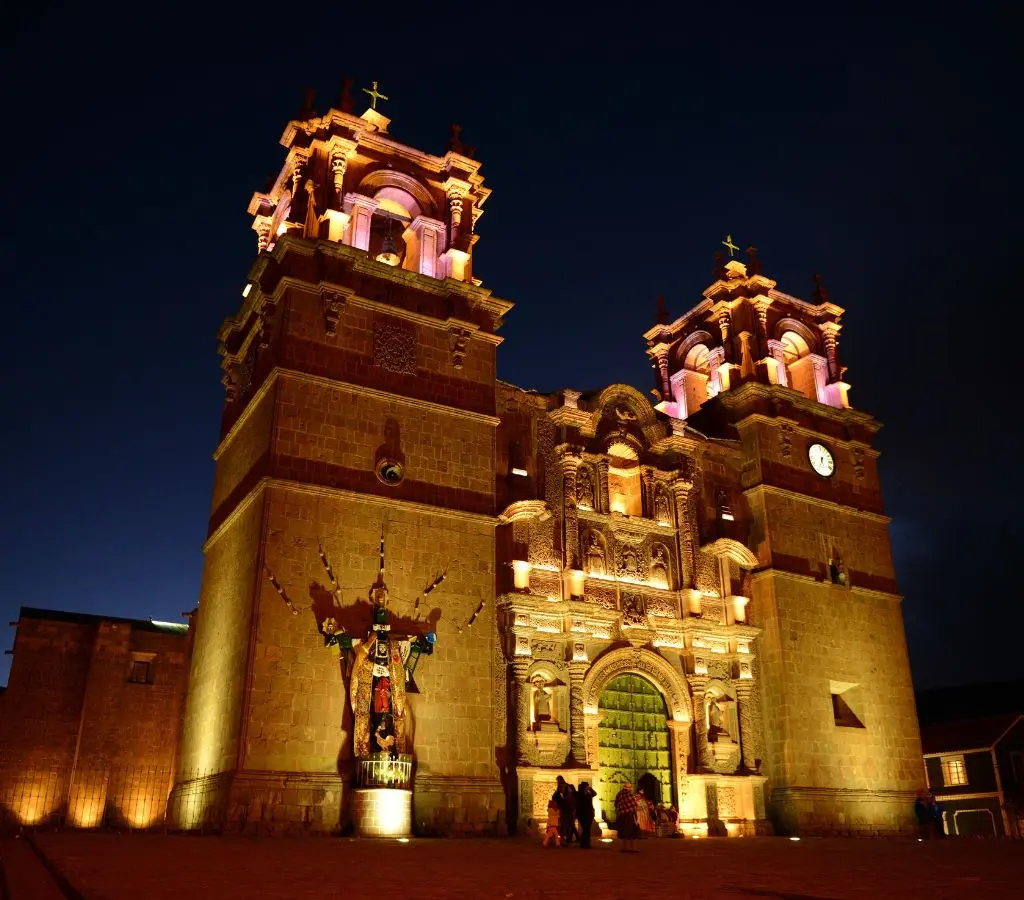
The Cathedral of Puno, officially known as the Minor Basilica of Saint Charles Borromeo, is one of the city’s main historical and cultural landmarks. It is located near the shores of Lake Titicaca and stands out for its Andean Baroque style.
It was built primarily with stone, a material that stands out on its façade and atrium. Inside, spacious and majestic, two highly revered images are preserved: the Lord of the Quinario (also known as the Lord of the Bullet) and the Virgin of Remedies, venerated since the earliest years of the colonial period.
History of the Cathedral of Puno
The Cathedral of Puno was completed in the late 1970s, although the exact start date is not known. The cathedral belongs to the Catholic Church in Peru, which granted it the rank of Minor Basilica through a papal bull issued by Pope Paul VI on October 13, 1965.
It was built on an ancient ceremonial site known as “Supay kancha”, which translates as the Devil’s Circle or Devil’s Enclosure. After the arrival of the Spanish, when you visit the Cathedral you’ll notice its silverwork, and inside it features several paintings from the Cusco School.
Regarding its construction, there is a lot of controversy about the date when building began. Some sources also say it took more than 50 years to complete, largely due to lack of funding. However, on the arch of one of the side doors the year 1974 is inscribed as the date when the Cathedral would have been finished.
It is also said that the people who built the temple were miners, along with local residents—adults and children—who helped by chiseling the stones. They would mark the carved stones with the initial of their name, showing the community’s support for the construction of the religious temple.
Main features
The Cathedral of Puno is a clear example of colonial architecture and features multiple European and Andean representations, blending both cultures.
Architecture of the Cathedral of Puno
As for the Cathedral’s architecture, it is made of carved stone in an “Andean Baroque” style, decorated with human figures, local flowers, and mermaids playing the charango.
This mix—or fusion—of Mestizo Baroque style was created between Europeans and Andean culture to help local people become familiar with the imagery, bring them closer to the Catholic Church, and evangelize them.
Inside, important figures and Catholic Church authorities such as bishops are buried. The main altar is made of marmolina with a silver front. You will also find two miraculous figures: the Lord of the Bullet and the Virgin of Remedies, as well as paintings from the 18th-century Cusco School of Painting.


Visiting hours
To visit the Cathedral of Puno, you can go any day of the week, but at different hours:
– Monday to Friday: from 8:00 AM to 12:00 PM, and in the afternoon from 3:00 PM to 6:00 PM.
– On Saturdays: from 8:00 AM to 1:00 PM, and in the afternoon from 3:00 PM to 7:00 PM.
– On Sundays only: from 8:00 AM to 12:00 PM, and in the afternoon from 3:00 PM to 7:00 PM.
Entrance fee
Admission to the Cathedral of Puno is free, so you can visit as many times as you like and take a closer look at the paintings it displays.
Location
The Basilica Cathedral of Saint Charles Borromeo—better known as the Cathedral of Puno—is located in front of the Main Square of Puno, at Jirón Ayacucho 416, in the Puno Region, Peru. It is one of the region’s most important architectural examples from the colonial period.
How to get to the Cathedral of Puno?
To get to the Cathedral of Puno, you only need to walk a few steps from the city’s historic center. If you are staying farther away, take a taxi and ask to be taken directly to the Cathedral.
You can also visit it as part of a tour in Puno, which will let you discover other attractive places around the city as well.
What to see inside the Cathedral of Puno?
The Cathedral of Puno has many highlights—for example, it helps you understand the meanings represented inside the church and learn more about the art showcased within.
Architecture in Puno
Cathedral interior
Inside, you can admire countless paintings from the Cusco School and two important and representative images for the faithful: the Lord of the Bullet and the Virgin of Remedies.
Admire the Baroque style
The Baroque style is fused with European and Andean elements. As a result, you’ll see carved images of pumas, birds, flowers, and mermaids playing a musical instrument—evidence of Andean artists who took part in its creation.
Sculpture and painted art
Among its artworks, you’ll find representative paintings from the Cusco School. European models were adapted to Andean reality and are reflected in the Cathedral of Puno.
Frequently asked questions about the Cathedral of Puno
Who designed the Cathedral of Puno?
Construction began around 1669 under the leadership of priest Silvestre de Valdez y de la Cueva, with the participation of Indigenous master builders, mestizo craftsmen, and missionaries (in other words, not a single “architect” in the modern sense).
The cathedral does not have only one author: it emerged as a collective work led by priest Valdez together with Andean master builders, and after the 20th-century fire it incorporated modern interventions such as the main altar by Harth-Terré.
What’s the difference between a basilica and a cathedral?
They are different titles that can coexist in the same church (as in Puno):
- Cathedral: the main church of a diocese because it contains the cathedra (the bishop’s seat); it is an administrative and pastoral role.
- Minor basilica: an honorary title granted by the Pope to a church due to its historical, liturgical, or devotional importance; it creates a special bond with the Holy See.
In the case of the Basilica Cathedral of Saint Charles Borromeo, the official tourism inventory records that it holds the rank of Minor Basilica by papal bull from Pope Paul VI (October 13, 1965), in addition to being a cathedral.
Can you take photos inside the cathedral?
In general, yes—photography/filming is allowed as a tourist activity at the site (official registry), but respectful rules may vary depending on Mass, ceremonies, or staff instructions.
Best practices (the ones I recommend) include:
If you want “pro” photos (tripod, lighting, long recording), it’s best to ask on-site and coordinate with the sacristan or the parish (the official inventory even lists contact information for arrangements).
No flash (to protect altarpieces, paintings, and gilded details) and never interrupt celebrations.