Taquile Island in Puno

Why is Taquile Island famous?
Taquile is best known for its textile art: a living tradition (woven by men and women of all ages) that functions as a social “language” within the community and was inscribed by UNESCO on the Representative List of the Intangible Cultural Heritage of Humanity.
Add to that its high-Andean scenery (natural viewpoints over Lake Titicaca) and its strong community way of life, which makes the visit more cultural than “just for photos.”
Location: Where is Taquile Island?
It’s on Lake Titicaca (Puno, Peru).
In MINCETUR’s tourism resources inventory, it’s listed as an island located 36 km east of the city of Puno.
Reference altitude: around 3,937–3,950 m (12,917–12,959 ft) above sea level in the main town; the highest point reaches approx. 4,050 m (13,287 ft).
How to get to Taquile from Puno and from the Uros Islands
From Puno (the most common option)
Go to the pier/port in Puno.
Then take:
- Full-day tour (Uros + Taquile), or
- A direct boat (depending on availability/season), or
- A speedboat (if you want to reduce travel time).
- From the Uros Islands to Taquile (on combined tours).
On Uros–Taquile full-day tours, it’s common for the route to be Puno → Uros → Taquile → Puno, because it makes the most logistical sense within the bay.
Boat travel time: speedboat vs. regular boat
Times vary by route, stops (Uros), weather, and boat type, but these ranges are very common:
Puno → Taquile
- Regular boat: approx. 2.5 to 3 hours.
- Speedboat: approx. 1 to 1.5 hours (some operators list 1h15 or even 45–50 min depending on service/speed).
Uros → Taquile
- Regular: approx. 2h30.
- Speedboat: approx. 1h16.


Taquile’s textile art
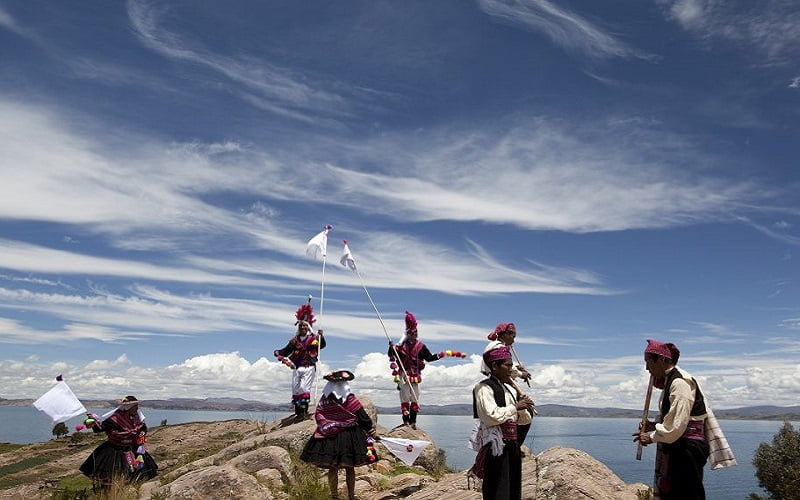
UNESCO explains that Taquile textiles are not just handicrafts: they are part of a community tradition in which garments are used in everyday life and communicate belonging and identity.
Meaning of the chullos and traditional clothing
On Taquile, the chullo (knitted hat) is a key garment for men, and its designs/colors vary depending on age, marital status, and social role.
Red chullo (married men)
- The deep red color indicates the man is married.
- It’s woven with fine wool, sometimes alpaca, and its quality reflects discipline, patience, and responsibility.
- A well-made chullo reflects a man who is respected within the community.
Red-and-white chullo (single men)
- Single men wear chullos with a red-and-white combination.
- It’s a clear sign within the community (and especially to women): he’s available for marriage.
- The design can vary, but the color code is widely recognized.
- Weaving as proof of personal value
- A key (and lesser-known) detail:
Men knit their own chullos. - A young man who doesn’t know how to weave is not considered ready for marriage.
- Weaving well shows maturity, self-control, and respect for tradition.
Women’s clothing: history, social role, and Andean elegance
Women’s clothing on Taquile is understated, symbolic, and powerful.
Dark polleras (skirts). Usually black or dark blue, they represent seriousness, stability, and a connection to the earth—not flashy in color, but rich in detail and meaning.
Lliclla (traditional shawl). Worn over the shoulders and secured with tupus (metal pins).
The geometric designs represent:
- Family.
- Territory.
- The Andean worldview.
Each lliclla can tell the story of the person wearing it.
Women’s role in weaving
Women are guardians of textile knowledge.
They teach children from a young age and pass down ancestral patterns that aren’t written in any book.
Where to buy authentic Taquile textiles
To buy “real Taquile,” look for direct purchases from the weaver (artisan market / community shops) and prioritize pieces where you can:
- See who made it.
- Ask how long it took.
- Identify the wool/material and technique (fine, even weaving).
As cultural background, UNESCO emphasizes that textile crafts are made by community members and worn by everyone—so authentic pieces usually come from local weaving families.
The climb on the island: the famous “500 steps”
From the dock to the central area (main square/town), you’ll usually climb about ~500 to ~560 steps (some itineraries mention 538).
Hike difficulty and effort level
The typical walk up to the town takes ~1 hour (it can be longer if you go slowly due to the altitude).
It’s moderately challenging: not technical, but the altitude + steps are noticeable.
Taquile altitude and tips for altitude sickness
With elevations around 3,937–3,950 m (and higher points near 4,050 m), the smartest approach is:
- Acclimate for 1 day in Puno if possible.
- Walk at a steady pace (don’t sprint the steps).
- Stay hydrated and avoid heavy alcohol the night before.
- Bring sunscreen, a hat, and a windbreaker (strong sun + wind).
Prices and logistics
Taquile Island entrance fee
This is handled as a local entrance/fee (sometimes included in the tour). Traveler-facing information often shows S/ 8 per island (Taquile/Uros) as a reference, and S/ 10 or $4 is also reported. The best way to phrase it is that it may vary and it’s worth confirming when you book your service.
Do you need a guide to visit Taquile?
It’s not mandatory to walk around the island, but it’s highly recommended for 3 practical reasons:
- Lake logistics: boat travel times, docking point, walking pace, and return time. A typical visit includes the climb to the main square (around 45 minutes in some circuits) and then the descent back to the dock.
- Real cultural interpretation: a guide connects what you see (chullos, belts, symbols, weaving roles) with its meaning, and keeps the experience from being “just photos.”
- Community rules and respect: helps you handle photography, shared spaces, and interactions with artisans/families appropriately.
If you’re a very independent traveler, you can also visit on your own (some guides explain both ways: with a tour or without), but it’s best to go with a clear plan – Uros & Taquile Full-Day Tour.
Food: What to eat on Taquile Island
On Taquile, the typical lunch for visitors is usually simple, local, and filling—ideal for high altitude:
- Starter: quinoa soup.
- Main course: trout (often fried or grilled) with potatoes and salad/rice.
- Herbal tea: local infusions / muña / coca (depending on the family or restaurant).
- The local diet (most commonly mentioned by travelers and operators).
- The classic combo you’ll hear again and again is: trout + quinoa soup.
Tips for a better experience
- What to bring: sun protection and proper footwear.
- Sunscreen is a must: the sun on Lake Titicaca is strong (altitude + reflection off the lake).
- Footwear: sneakers/hiking shoes with good traction (there are stone/dirt sections and stairs; the climb to the main square can feel demanding if you’re not acclimated).
- Layers: cold morning, sunny midday, windy afternoon.
- Cash: Taquile mostly runs on cash, and banking facilities may not be available.
- Respect community rules and photography.
- Golden rule: ask permission before taking photos of people (basic respect and helps avoid issues).
If you’re planning something more “pro” (a formal shoot/recording): filming requires authorization from the Taquile Community Center, including information about your project and route.
Frequently asked questions about Taquile Island
How much time do you need to explore Taquile?
For a classic experience, plan a full day from Puno (because of the boat transfers). On the island, a typical circuit includes the walk up to the main square, lunch, and free time before heading back down to the dock.
Can you stay overnight on Taquile Island?
Yes. There are community tourism options / homestays, with rustic comfort (sometimes limited electricity, little or no connection, and basic services). That’s part of the experience: silence, starry skies, and shared daily life.
What’s the best time of year to visit Taquile?
In general, the best season for Taquile and Lake Titicaca is the dry season (roughly May to September, or more broadly April to November depending on the source): clearer skies and more comfortable walks.
Is there internet signal or electricity on the island?
It can be limited. Several community-stay descriptions mention limited electricity and that the island uses solar energy in part; connectivity can be intermittent or weak. Come and discover for yourself the mystery behind Taquile Island!