The Twelve-Angled Stone of Cusco
What Is the Twelve-Angled Stone?
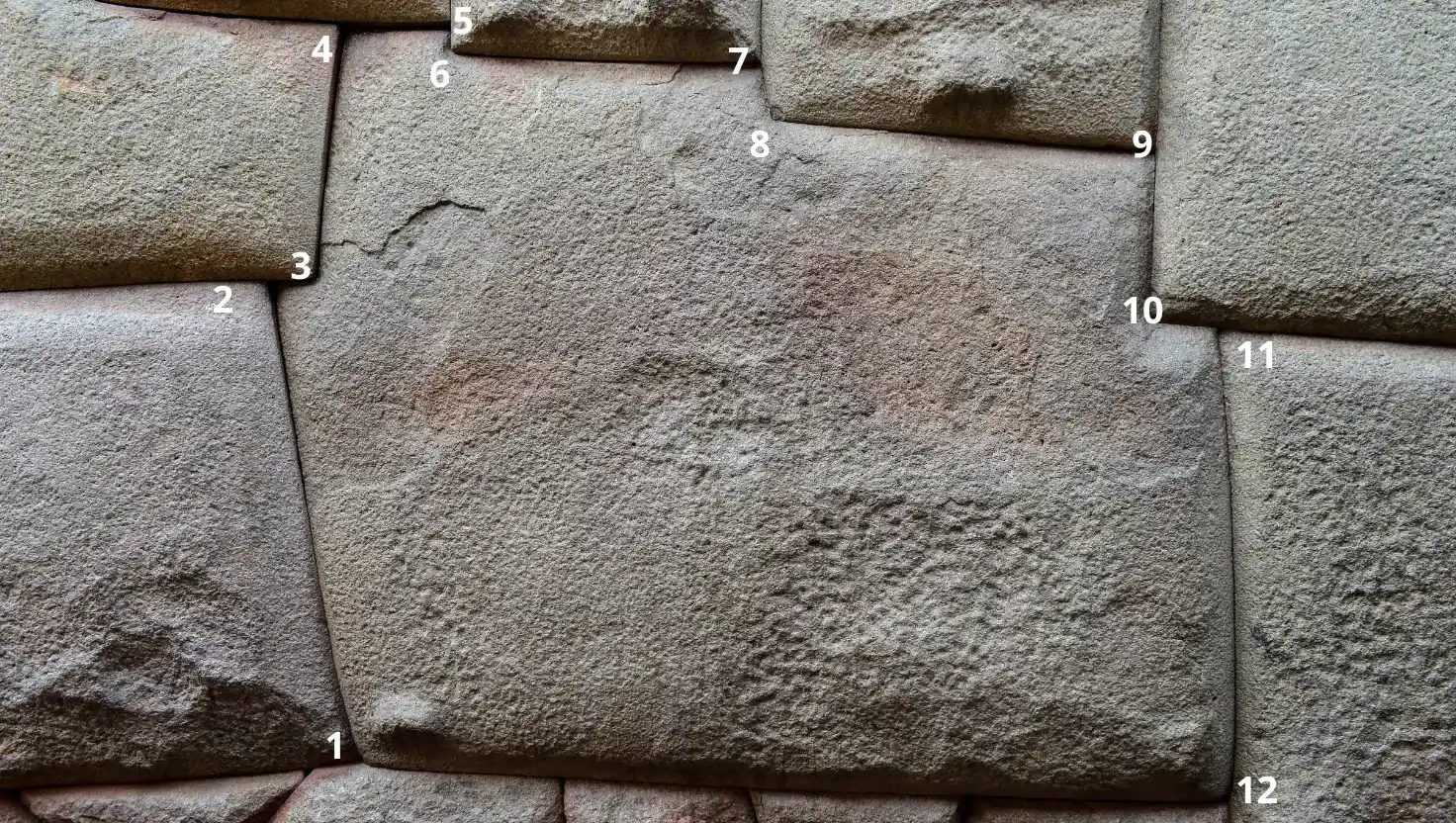
The Twelve-Angled Stone is a finely carved stone block that forms part of an ancient Inca wall built in the imperial style. It is famous for having twelve perfectly fitted angles that interlock with the surrounding stones without the use of mortar.
It is considered a masterpiece of Inca engineering and architecture, and one of the clearest examples of the high technical level achieved by this civilization.
More than an isolated stone, it represents the perfection of the Inca construction system, based on precision, stability, and harmony.
Where Is the Twelve-Angled Stone Located?
How to Get There from Cusco’s Main Square (Plaza de Armas)
On foot (3–5 minutes)
From the Plaza de Armas, walk toward the Cathedral, take Triunfo Street, and continue until the street becomes Hatun Rumiyoc.
The stone is located on the left-hand wall, clearly marked and usually surrounded by visitors.
No transportation is required; access is completely pedestrian.
Exact Location
It is located on Hatun Rumiyoc Street in Cusco’s Historic Center. It forms part of the wall of the former Palace of Inca Roca and is just one block from the Plaza de Armas.
Hatun Rumiyoc Street (Quechua for “the great stone street”) preserves extensive original Inca walls and is one of the best examples of pre-Hispanic urban planning still in use today.
History of the Twelve-Angled Stone
The stone was carved during the height of the Inca Empire (15th century), when Cusco was the capital of the Tahuantinsuyo.
It formed part of the Palace of Inca Roca, the sixth Inca ruler and founder of the Hanan Cusco royal lineage.
After the Spanish conquest, many Inca palaces were destroyed; however, the strongest walls—such as this one—were preserved and reused as foundations for colonial buildings, allowing them to survive to the present day.
The Palace of Inca Roca and Its Architecture
The palace belonged to the ruling elite and was built using green diorite stone, an extremely hard material. Its architecture follows the Inca imperial style, characterized by:
- Polished stone walls
- Perfect stone joints
- Total absence of mortar
- Slight inward inclination for greater stability
These palaces were not only residences but also administrative and political centers.
Who Built the Twelve-Angled Stone?
It was built by master Inca stonemasons, highly trained specialists who worked exclusively for the State.
These artisans used:
- Stone hammers
- Abrasion with sand
- Visual and tactile measurement
- Years of work for a single section of wall
Iron and steel were unknown to the Incas, which makes the level of precision achieved even more impressive.
Meaning and Mysteries of the Twelve Angles
Symbolic Interpretations
There are no written Inca records, but several theories exist:
- Representation of the 12 royal panacas (Inca noble families)
- Symbolism of order, balance, and state power
- A demonstration of technical superiority over other cultures
Inca Technology and the Seismic Resistance of the Wall
The wall where the stone is located is earthquake-resistant thanks to:
- Perfect polygonal stone fitting
- Stones of different shapes that distribute seismic energy
- Slight inward inclination of the wall
- The ability to “move” without collapsing during earthquakes
This system has allowed Inca walls to withstand centuries of earthquakes, while many colonial structures collapsed.
Guide to Visiting the Twelve-Angled Stone
Is It Free to Visit?
Yes, it is completely free.
It is located on a public street and does not require an entrance ticket.
Recommended Hours and Best Time for Photos
Early morning (7:00 – 9:00 a.m.) → fewer people
At night → artificial lighting highlights the angles
Avoid peak hours (10:00 a.m. – 4:00 p.m.)
Visitor Rules: Why Is Touching the Stone Prohibited?
- Human contact accelerates stone erosion
- Natural skin oils damage the polished surface
- The stone has suffered deterioration from constant touching in the past
For this reason, it is protected by municipal regulations and is permanently monitored.
Technical Characteristics of the Stone
Type of Rock and Approximate Weight
The Twelve-Angled Stone is carved from green diorite, an extremely hard igneous rock composed mainly of plagioclase and hornblende. This material was widely used by the Incas in elite constructions due to its strength and durability.
- Approximate height: 1.20 meters
- Approximate width: 0.90 meters
- Estimated thickness: 0.60 meters
- Approximate weight: between 5 and 6 tons
These figures are technical estimates, as the stone is an integral part of the wall and has never been removed for direct measurement.
The Perfect Fit Without Mortar
One of its most impressive features is its perfect polygonal assembly, where:
- No mortar or binding material was used
- The joints are so precise that not even a sheet of paper can fit between them
- Each angle was carved to fit a specific neighboring stone
This system:
- Increases structural stability
- Allows the wall to absorb seismic movements
- Prevents collapse during earthquakes
- Is an exceptional example of Inca earthquake-resistant engineering
What to See Near the Twelve-Angled Stone
The San Blas Neighborhood
Just a few meters from the stone is the San Blas neighborhood, one of the oldest and most charming areas of Cusco.
Highlights of San Blas:
- Narrow cobblestone streets
- Traditional artisan workshops
- Natural viewpoints
- Cafés and art galleries
Historically, it was the neighborhood of Inca artisans (amautas and kamayoc).
The Religious Art Museum
Located very close by, inside the former Palace of Inca Roca, this museum preserves:
- Paintings from the Cusco School of Art
- Colonial altarpieces
- Religious sculptures
- The superimposition of Inca and colonial architecture
It is an excellent cultural complement after visiting the stone.
Frequently Asked Questions About the Twelve-Angled Stone
Where exactly is the Twelve-Angled Stone located?
On Hatun Rumiyoc Street in Cusco’s Historic Center, forming part of the wall of the former Palace of Inca Roca, one block from the Plaza de Armas.
How much does it cost to see the Twelve-Angled Stone?
There is no cost. The stone is located in a public area and can be viewed completely free of charge.
Why is touching the Twelve-Angled Stone prohibited?
Because:
- Human contact causes progressive wear
- Natural skin oils damage the surface
- The stone has been damaged in the past by constant touching
- It is protected by municipal and heritage regulations
What do the twelve angles of the stone mean?
There is no definitive written record, but the most accepted theories suggest:
- Representation of the 12 Inca royal panacas
- A symbol of order, power, and imperial organization
- A demonstration of technical and aesthetic mastery
What is the best time to visit and avoid crowds?
- Very early in the morning (6:30 – 8:30 a.m.)
- At night, when it is illuminated
Avoid peak hours: 10:00 a.m. – 4:00 p.m.
Which Inca ordered the construction of the palace?
The palace was commissioned by Inca Roca, the sixth ruler of Cusco, belonging to the Hanan Cusco dynasty.
What material is the stone made of?
Green diorite, one of the hardest rocks used by the Incas in monumental architecture.
How big is the Twelve-Angled Stone and how much does it weigh?
- Estimated weight: between 5 and 6 tons
- Approximate dimensions: 1.20 m × 0.90 m × 0.60 m